Poor Samsung Galaxy Alpha: it's actually a lovely compact version of the Galaxy S5 but it won't get the attention it deserves in the US. Why not? It launched within a week of the iPhone 6, Samsung's gadget spamming means shoppers are weary of so many Galaxy variants and lastly it's exclusive to just one US carrier. Granted that carrier is AT&T, with an excellent network and very large customer base, but exclusives take the shine off of even very good smartphones. Overseas, you'll find greater carrier choice, and the Alpha may thus do better outside the US.
The name Alpha implies top dog status, but the Galaxy Alpha is a bit of a mixed message: it's the first Samsung Galaxy to have a metal frame around the edges (the Galaxy Note 4 will soon join it) and it's meant to be the classy model. It's also downsized and with those straight metal edges like the iPhone 5s, it's designed to compete with the 4.7" iPhone 6 that ironically uses a completely new design. The Alpha, like the Sony Xperia Z3 Compact, downsizes the standard sized flagship (the Galaxy S5 in this case) without dumbing down the specs too much. Thus the Alpha has a 4.7" Super AMOLED display, the same 2.5GHz quad core Snapdragon 801, 2 gigs of RAM and 32 gigs of storage. It has a 12MP camera that takes photos and videos that are nearly indistinguishable from the 16MP GS5 and it has a fingerprint scanner embedded in the home button. Sounds lovely if you prefer a more manageable size phone and better looks than the Galaxy S5. The specs and design are certainly above the Samsung Galaxy S5 Mini, which is the 4.5" reduced spec version of the GS5.
So what are you giving up? The Galaxy Alpha, unlike most Samsung Android Galaxy phones, has no microSD card slot. Samsung somewhat makes up for that with double the storage from the GS5, but those of you who carry extremely large video and music libraries might not like the Alpha. The back camera resolution drops, but given the same excellent features and quality as the GS5, I'm not bothered. The display is 1280 x 720 rather than 1920 x 1080. Android phones 4.7" and under don't get 1080p displays (the LCD-equipped HTC One M7 is the exception), and honestly it's not terribly worthwhile to move up to full HD when most eyes won't see the difference. The display is that wildly saturated and contrasty Super AMOLED that Samsung fans love, but at 720p, the diamond PenTile matrix does cause a bit of haloing around text here and there. It's not easy to spot, but Android folks are obsessed with specs and have already condemned the poor Galaxy Alpha, sight unseen. We here at MobileTechReview have obviously not only seen the display in person, we've used it for a week, and I can tell you overall it's a really lovely screen. The IR blaster and AV remote control found on the Galaxy S5 and Galaxy Note 3 isn't here either, nor is the GS5's water resistance. What are you left with? A pocket and smaller hand-friendly Android 4.4.4 KitKat phone with the same CPU found on the big flagships, a bright and very colorful display and a very good camera.
In the US, the Samsung Galaxy Alpha sells for the same $199 with 2 year contract as the Samsung Galaxy S5 and iPhone 6. That hurts since most folks will notice the lower spec items on the Alpha and expect a lower price tag. The full retail price is $612.99, which is a bit lower than the $650 full retail for the 16 gig GS5 and iPhone 6, but at $599 or less it would attract more buyers.
Design and Ergonomics
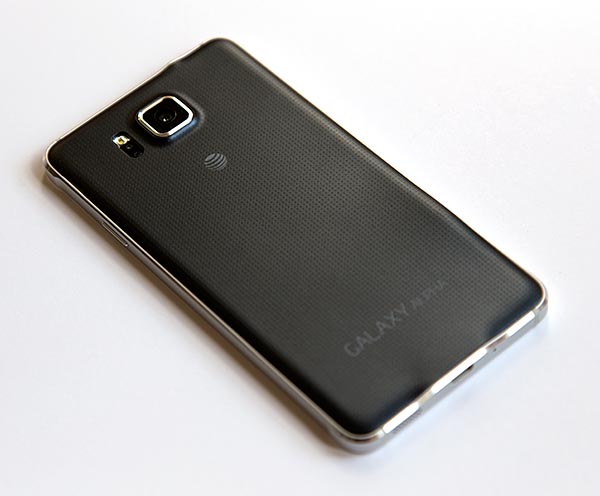
From the side and front angles, it's hard to not notice the similarity to the iPhone 5 and 5s: those straight anodized aluminum sides with chamfered edges bear a strong resemblance to Apple's phone. But from the full frontal or rear views, it's all Samsung. In fact, I've observed that at first glance most folks haven't noticed that the metal sides are real metal rather than some more tasteful variation of Samsung's faux trim. The elongated home button, big Samsung logo above the display and curved corners say "I'm a Galaxy" clearly. The back is still stippled plastic, made to look somewhat like leather at first glance (at least the soft touch black model, the white pearlescent and shiny bright gold backs don't look the least bit like leather). Given the usual glass front and plastic back, it would be wrong to call this Samsung's first metal body or metal chassis phone: the metal is simply the edging material. That doesn't mean it isn't an attractive phone; it's definitely the best looking Samsung phone yet.
The 4.7" size is the sweet spot for hand and pocket comfort. The past year has been a race to make phone screens bigger, and phablets are even going mainstream thanks to the Samsung Galaxy Note and now iPhone 6 Plus. But for those of you who love the size and feel of the first gen Moto X and the new iPhone 6, pickings are slim if you want a high quality smaller phone. The phone is incredibly light at 4.03 ounces (the iPhone 6 is 4.55 ounces) and slim at 0.26" (the iPhone 6 is 0.27"). It's small enough to use one-handed and doesn't require super-sized pockets.
Samsung continues to use a physical home button, and as with the Galaxy S5 that button doubles as the fingerprint scanner. We noted improvements in the Alpha over the Galaxy S5 in terms of accuracy (it works the first time 90% of the time) and it now supports swiping your thumb sideways, which is handy when unlocking the phone using one hand. Given the required swipe gesture and still not perfect accuracy, it's not as pleasant to use as Apple's Touch ID, but it's a big step in the right direction.
The home button is flanked by capacitive multi-tasking and back buttons, and I found these harder to accidentally activate compared to the GS5. The home button is stiffer compared to the GS 5 and Note 3, and the metal side buttons are firm with a nice tactile click when actuated. The volume controls are on the left and the power button is on the right. The headphone jack is up top and the single speaker is on the bottom edge, just like the iPhone 5 and 6. The smartphone has a micro USB 2.0 port rather than the 3.0 port on the GS5 and Note 3 (I doubt many of you will care).
The wafer-thin plastic back cover is removable, which is quite a feat with a phone this slim. The back cover doesn't scream quality, but it's not bad looking either. I'm not a fan of the gold back because it looks like gold spray paint, but the slightly iridescent white isn't bad. The black is matte and soft touch, and it looks the most like leather and is the least slippery. Thanks to the straight sides, the phone isn't slippery by design, so the back material is less of a concern. Under the back cover you'll find the removable 1860 mAh battery and nano SIM card slot (this is the first Samsung Galaxy we've seen with a nano rather than micro SIM). Out of the box, the Alpha doesn't support wireless charging, but overseas there are Qi wireless charging backs for sale.
Display
Here's the make it or break it part for many of you. Some folks won't buy anything that isn't full HD 1920 x 1080 anymore, be it a smartphone, tablet or TV. The fact is, phones this small don't get 1080p displays because the difference wouldn't be that visually apparent and higher resolutions eat into power reserves on these necessarily smaller battery phones. I don't believe Samsung ever developed a Super AMOLED display that was full HD and less than 5". At 312 PPI, just shy of the iPhone 6 Retina Display 326 PPI, I don't think many folks will find this display grainy or pixelated. In fact, it's quite sharp and as with most Super AMOLED displays, looks best when watching videos or looking at photos. It has the usual better than sRGB color gamut, deep blacks and extremely high contrast that are hallmarks of Super AMOLED. It's fairly bright too, and is visible outdoors at higher brightness or auto-brightness settings. The panel uses a diamond PenTile matrix layout, and keen-eyed folks may see some haloing around text. This is the same display technology used in the Note 3, which has a higher pixel density to reduce such artifacts. That said, text is sharp and clear, and it's not unpleasant for reading. Whites have a pinkish cast compared to better IPS panels and the Galaxy S5 that has the best Super AMOLED display we've seen on a Samsung phone.
As usual, Samsung offers a few color settings including an AMOLED photo mode that's closest to accurate in terms of colors. The active mode changes the display depending on the app used, so colors and contrast are boosted when playing movies and white backgrounds are toned down in Google Play Books.
0 comments:
Post a Comment