Samsung's making phones that capitalize on good looks--who'd have predicted that 2 years ago. That company known for its feature rich (sometimes too rich) plastic Android smartphones with uninspired designs has trumped Apple with the Samsung Galaxy S6 edge and now the Samsung Galaxy S6 edge+. The edge+ makes the iPhone 6 Plus look a little pedestrian. It's the phone for those of you who coveted the Galaxy S6 edge but longed for a phablet sized screen. Despite that huge 5.7" display, the phone isn't gargantuan since Samsung has done an excellent job shrinking bezels and no doubt cramming internals to make this 5.4 ounce phone. The downside? No removable battery and no microSD card slot. The IR blaster and AV remote that have been standard fare on high end Galaxy phones, including the 5.1"standard GS6 edge, is gone. If design and premium materials are more important to you than the loss of those features, read on. This won't be a long review since this is basically the super-sized version of the S6 edge we reviewed in March 2015.
The Samsung Galaxy S6 edge+ has a 5.7" Super AMOLED QHD display, a 5MP front and 16MP rear camera, WiFi 802.11ac, Bluetooth, NFC, GPS, a fingerprint scanner and a heart rate monitor on the back under the LED flash. It runs Android 5.1.1 Lollipop with Samsung's lightened TouchWiz software on the 2.1 GHz Octa-core Exynos 7420 CPU with 4 gigs of RAM and 32 or 64 gigs of UFS 2.0 fast storage. It has a 3,000 mAh battery with quick charging and it supports Qi wireless charging. The phone will support Samsung Pay, Samsung's counter to Apple Pay.
Design and Features
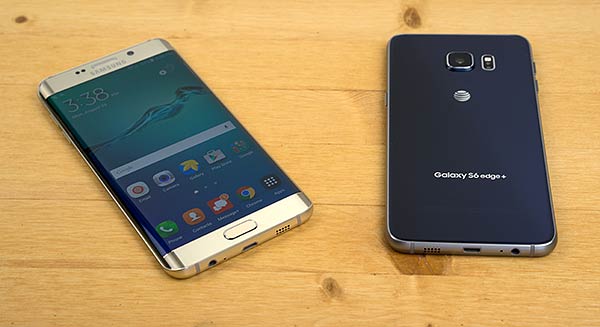
This really is just a bigger version of the Galaxy S6 edge. The design is identical, control locations are the same and the edge display works similarly. It speaks well of Samsung's design that it translates well to a significantly larger phone--some designs lose their elegance when blown up. Like the standard S6 edge, this is an unabashedly slippery phone, clad in Gorilla Glass 4 front and back, with just a sliver of aluminum on the sides for modest grip. The curved sides make it harder to pick up the phone from a desk, but it feels nice when your fingers wrap around the front curves. Of course, you'll need large hands to do that, and it's not as comfy as the Samsung Galaxy Note 5's reverse curve (its curves are on the backside). Speaking of the Note 5, the Galaxy S6 edge+ is not a part of the Note family and it doesn't bring the Samsung Galaxy Note Edge's more powerful edge screen features to the table. In terms of size, the edge+ and Note 5 are nearly identical, and they share the same battery capacity, processor, RAM, storage options, fingerprint scanner and cameras. In fact, the standard 5.1" size Samsung Galaxy S6 and S6 edge also use the same CPU and cameras. Our Note 5 and GS6 edge+ share some review sections given their similarity (camera, CPU and display technology other than the curves).
Like the S6 edge, the edge+ lets you use an edge (either one, your choice) as a bedside clock. When the phone is asleep, you can run your finger along the edge to check for notifications and news. I've never really mastered running my finger up and down the edge on my GS6 edge, and I find it no more compelling on the bigger model. It takes a lot of swiping to wake it up, so it doesn't feel like a time saving feature. The edge+ has the same contacts edge launcher for your favorite peeps (color coded so you'll know who's calling even when the phone is face down). It adds an app launcher, a feature I really enjoyed on the Galaxy Note Edge since it reduces home screen clutter and visits to the multitasking button.
Curved Display
There's still nothing quite like the Galaxy S6 edge and edge+ curved displays. They just look so darned beautiful when the phone is turned on and even when asleep. When powered off, the display visually melts into the black model's bezels for a unified look. We aren't distracted by the display wrapping around the edge or by the slight distortion at the apex of the curve, but I suggest you play with one in person, since this is a matter of preference and perception. While Samsung's intelligent touch rejection worked well to stop me from accidentally activating things on screen on the smaller S6 edge, the bigger S6 edge+ does sometimes react to side screen touches. No doubt because it's an even larger phone with a bigger strip of glass to accidentally hug with the hand. That said, the Note 5's nearly nonexistent side bezels result in more accidental screen activations than on the edge+.
The 5.7" QHD 2560 x 1440 Super AMOLED display is one of the best if not the best currently available on the market (the same is true of the Galaxy Note 5's display since they're the same other than the curves). It vastly surpasses the sRGB color gamut and is the brightest Samsung display yet. It's easily visible outdoors in sunlight as long as you have auto-brightness enabled or manual brightness set high (gone is that weird outdoor mode that distorted the display on last year's Note 4). As per usual for Samsung's higher end Galaxy models, you can choose from several color presets. The default is adaptive display mode that alters various colors' saturation, brightness and contrast to suit the content being displayed. There's a %100 sRGB mode for those who don't like those Super AMOLED intense colors that are pretty but unnatural. The display has relatively low reflectance (as glossy touch screens go), so glare isn't maddening. Of course, if you don't mind carrying a large phone, your reward is a huge screen for watching movies, viewing photos and it acts as an immense viewfinder for the camera.
Calling and Data
Samsung's mid to high end phones have excellent voice quality, and the Galaxy S6 edge+ is no exception. Incoming and outgoing voice are crisp and clear with good volume, and as with the Galaxy Note 5, there's an Extra Volume button on screen when in a call if you need boosted earpiece volume.
This is a 4G LTE phone that supports HD voice (if offered by the carrier), including calling over LTE. Data speeds are of course carrier and coverage dependent, and here in the Dallas area where AT&T coverage is very strong we've seen insanely fast download speeds up to 61 Mbps using the Speedtest.net app. Verizon also put in a good showing at 36 Mbps. The phone supports the usual mobile hotspots and will do WiFi calling if your carrier supports that service.
Horsepower and Performance
The Samsung Galaxy S6 edge+ runs Android 5.1.1 Lollipop with Samsung's TouchWiz software on the same Exynos 7420 2.1 GHz octa-core 64 bit CPU as the Galaxy S6 family and the Note 5. These are some of the fastest phones on the market today. Unsurprisingly, the Galaxy S6 edge+ benchmarks similarly to those phones, and has yet to balk or lag in our week of testing. That's high praise since Samsung's TouchWiz overlay, lightened though it is, still adds quite a bit of overhead. That multi-window multitasking, Smart Stay and gesture awareness require CPU cycles, and then there's the ever-present FlipBoard.
The phone is available with 32 or 64 gigs of fast UFS 2.0 flash storage and there's no SD card slot. I know some of you would like to see a 128 gig version since you can't use a microSD card, and I'd have loved that too (I'd love an SD card slot even more!). Given the high retail price of the 64 gig model (~$900), I suspect Samsung thought a 128 gig would be more expensive than the market would bear.
0 comments:
Post a Comment