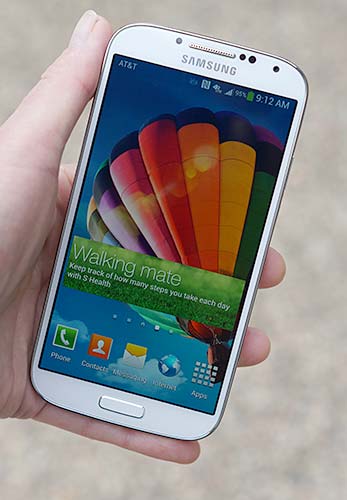
What has an excellent 5" full HD display, TouchWiz and is clad in shiny, slippery plastic? You got it: the Samsung Galaxy S4. In this review we look at the AT&T version, and that means we get to test this flagship Android smartphone on a robust LTE network. For those who aren't up to speed on this lovely smartphone's specs, the Samsung Galaxy S4 has a 1920 x 1080 Super AMOLED display, a very good 13 megapixel rear camera with HDR, LTE 4G, NFC, GPS with GLONASS, an IR AV Remote, a removable 2600 mAh battery and a microSD card slot. It's the follow up to the very popular Samsung Galaxy S III, and though the display is a bit larger, the S4 itself isn't larger and it's a tad lighter. It will be available on all major US carriers, several smaller US carriers and on many carriers overseas. The phone is available now on AT&T in the US and Sprint, T-Mobile will follow soon after and the Verizon Wireless version will be available by the end of May.
Design and Ergonomics
For a 5" smartphone, the Samsung Galaxy S4 is remarkably compact and light at just 4.6 ounces. It's a hair smaller than the 4.7" HTC One, smaller than the 5" Sony Xperia Z and just a hair taller than the 5" Sony Xperia ZL that's currently the smallest 5" phone on the market. Though it looks like a near clone, the GS4 is significantly smaller than the 5.5" Samsung Galaxy Note 2. At 0.31", it's extremely thin, and that makes it easier to hold than you might expect for a large smartphone.
Yes, it's shiny plastic and doesn't exude the sense of quality that the aluminum body HTC One and iPhone 5 do, and it's not machined and finished in an interesting fashion like the also polycarbonate Nokia Lumia 920 or HTC One X+. It's still a very nice looking phone, and the faux metal side trim is convincing. That trim breaks up the plastic monotony and makes the phone look appealing. The bad news is that it's still incredibly slippery and the rear camera lens protrudes a little bit, so it's the first thing that hits the table. The good news is that the finish and materials are very durable and the back is removable so you have access to the battery and a microSD card slot. The Galaxy S4 is available in white and black. The black model has a mirror finish.
Typical of Samsung, the power button is on the upper right side and the volume rocker is on the upper left (perfect for right handed folks). The 3.5mm headset jack is up top, the micro USB port is at the bottom and the SDXC microSD card slot is under the back cover. The phone syncs and charges via the micro USB port and it supports USB host OTG. We tested it with our USB OTG cable and flash drives and it worked perfectly.
Samsung went with straight sides rather than the very curved sides on the Galaxy S III and fairly curved sides on the Galaxy Note II. That's a small but significant design improvement because it's much easier to grip and pull out of a pocket or purse. In comparison, the Galaxy S III was akin to a slippery bar of soap that drove me mad. The front has a physical Home button (the kind that moves) and it's flanked by capacitive, backlit Menu and back buttons. As ever, these are very sensitive to touch and they're close to the edge, so I find them easy to accidently press. Since the phone has a full suite of buttons, you'll never lose screen real estate to on-screen buttons as you do on the Nexus 4 or HTC One when a menu button is required.
Calling and Data
The first thing I said after using the Samsung Galaxy S4 is that it sounded just like my Galaxy Note 2, and that's a good thing. The Note 2, Galaxy SIII and Galaxy S4 have excellent incoming and outgoing voice quality with good volume. In fact, there's no background noise or hiss on our AT&T model, and I sometimes wondered if the call had dropped during lulls in conversation. The phone ships with stereo earbuds with an inline mic and you can use it with Bluetooth headsets, car kits and external speakers. Call quality through Bluetooth was excellent.
Data Speeds on AT&T's LTE network were likewise excellent, coming in slightly ahead of the HTC One and identical to the Note 2 and Galaxy S III on the same network. Our phone averaged 18.5Mbps down and 16Mbps up on AT&T's LTE network in the Dallas area. Reception is also very similar to the S3, HTC One and Note II. We had no problem with dropped calls.
0 comments:
Post a Comment